
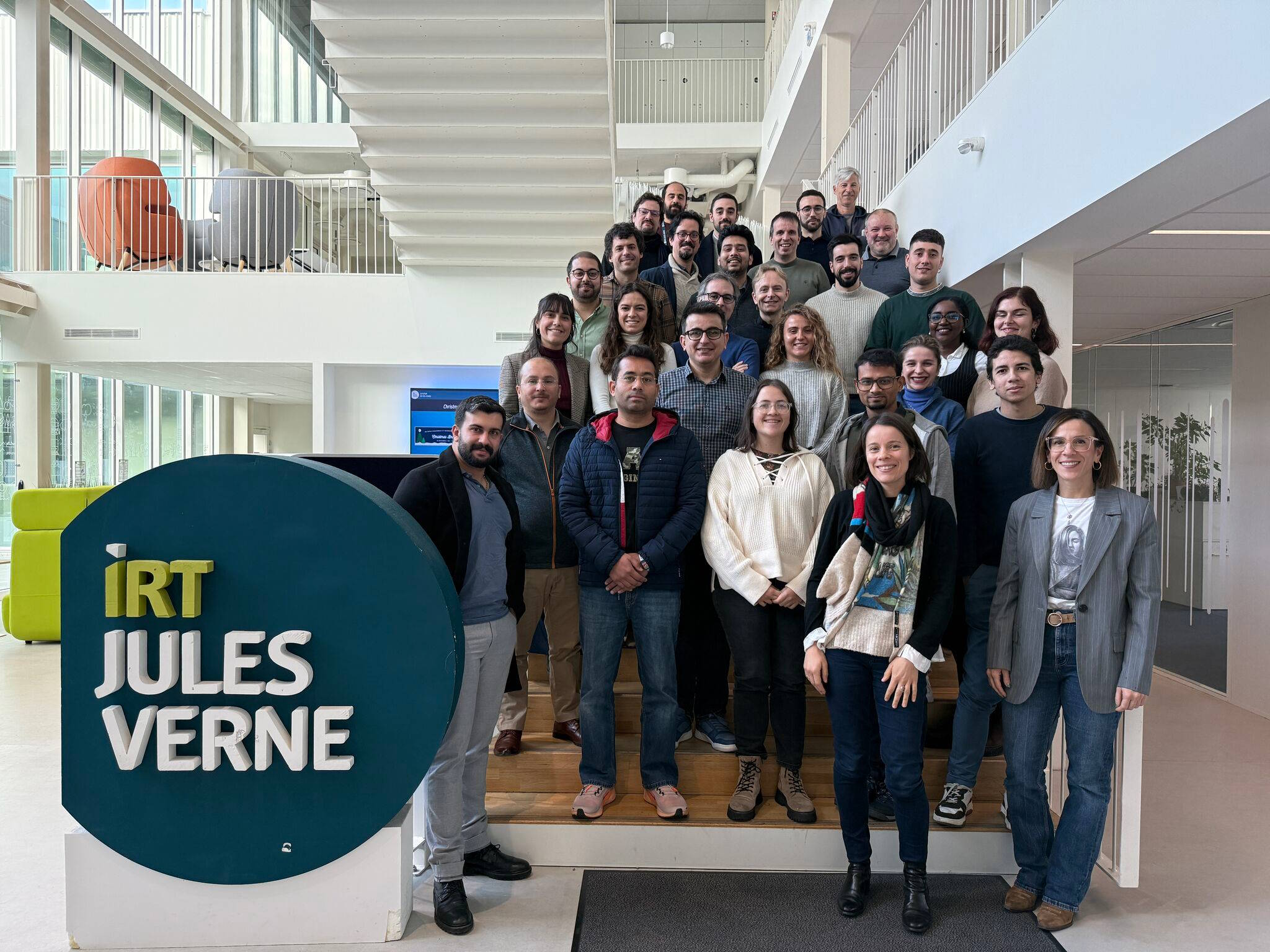
When the pAIramid consortium gathered in Nantes on 26–27 November 2025 for its first in-person General Assembly since the project’s launch, the meeting marked more than a formal milestone in the project calendar. One year after launch, it offered a moment to not only review progress after twelve months of work, align on next steps, and strengthen collaboration across disciplines and organisations, but also focus on the collaborative engine that is driving the project forward.
Hosted by IRT Jules Verne, the two-day meeting brought together partners from across Europe, representing complementary expertise in materials, manufacturing, modelling, artificial intelligence and certification. With the foundational phases of the project now complete, discussions focused both on consolidating what has been delivered and on preparing the ground for the more integrated development and validation activities ahead.
Over the past year, Work Packages 1 to 4 have established the conceptual and technical foundations of pAIramid. Partners reviewed progress on requirements definition, materials and process development, and the early stages of modelling and simulation activities that underpin the project’s AI-enabled virtual testing approach, confirming that across the different working lines, planned activities are advancing in line with the Grant Agreement.
Importantly though, the General Assembly also served as a forum to identify shared challenges and dependencies between work packages, ensuring that upcoming developments remain aligned across the consortium. Key to the value of the General Assembly was the opportunity for in-depth technical dialogue between partners who do not always interact directly in day-to-day tasks. Correspondingly, sessions were structured to encourage discussion across materials, manufacturing, modelling and validation perspectives, while maintaining a high-level focus suitable for collective exchange. This allowed partners to, beyond the presentation of results, focus on methodologies, interfaces between activities, and lessons learned so far, allowing the consortium to building a common understanding of progress and risks. Unsurprisingly, the diversity of perspectives within the consortium – academic, industrial and technological- proved to be a source of insight rather than complexity, with partners repeatedly emphasising how exposure to different viewpoints helps anticipate challenges and uncover opportunities that would be difficult to identify alone.
With the project now moving beyond its initial setup phase, discussions naturally turned towards the coming months. The next period will see increased integration between materials development, manufacturing processes, AI-supported modelling and validation activities. Notably, the General Assembly confirmed the importance of close coordination as the project progresses towards demonstrator-level validation and the preparation of tools and data for virtual testing workflows. Partners also reflected on the need to anticipate regulatory and certification considerations early, in line with pAIramid’s ambition to contribute to future virtual certification practices in aviation.
Beyond the formal agenda, the meeting reinforced the collaborative spirit of the project. Informal exchanges, joint problem-solving and a guided tour of IRT Jules Verne’s facilities provided valuable context and strengthened working relationships across the consortium.
The project coordination team acknowledged the collective effort behind the project’s first-year achievements, thanking all partners for their engagement and commitment. Special thanks were extended to IRT Jules Verne for hosting the event, and to the project coordinator for steering the consortium through its first year.
As pAIramid enters its second year, the General Assembly in Nantes marked both a checkpoint and a springboard. The consortium leaves the meeting with a shared view of progress, a clearer picture of upcoming priorities, and renewed momentum to advance AI-enabled virtual testing for next-generation composite aerostructures.
Look forward to further insights from the General Assembly, along with perspectives from partners and researchers, to be shared in upcoming newsletter issues and articles!
.
Get in touch with pAIramid for any questions, project updates or to discuss potential collaborations.

This project has received funding from the European Union’s Horizon Europe research and innovation programme under grant agreement No 101192736.
